.png)


Sacred Foods:The Magic of Mexican Mushrooms
By Catherine Marenghi
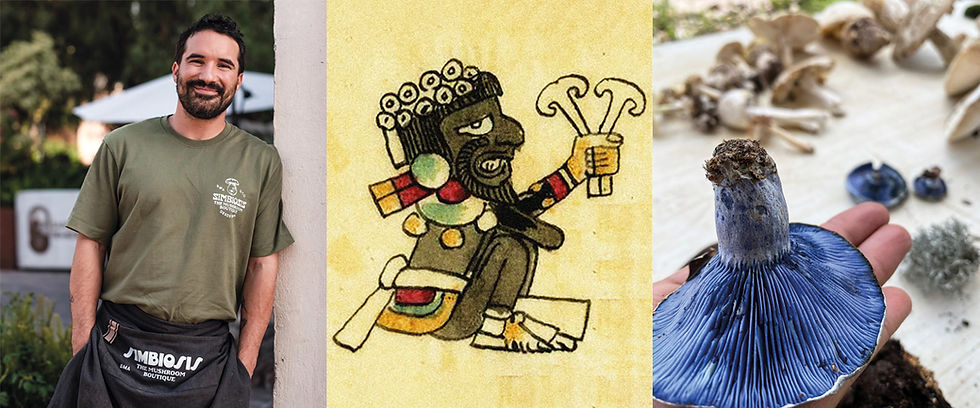
Indigenous peoples of Mexico have treasured mushrooms for millennia, integrating them into spiritual life, healing practices, and daily sustenance. Their traditions are preserved in códices, ancient iconography, and later colonial-era accounts. Carved “mushroom stones” found in Maya regions date as early as 1,000 BCE. Some include supernatural figures on the stems, suggesting ritual significance. Early Spanish chroniclers also documented ritual mushroom use among Mesoamerican peoples. Today Mexico is recognized as one of the world’s most biodiverse fungal kingdoms, second only to China, with over 7,000 documented species and around 400 edible Mexican mushrooms.
Few people have a greater passion for mushrooms than San Miguel’s Arif Towns Alonso, an expert mycologist and founder of Simbiosis: The Mushroom Boutique, at Mercado Sano. “Since founding Simbiosis in 2014, my goal was to create a community that celebrates the fungal kingdom in all its dimensions—gastronomy, design, art, natural medicine, and sustainability.”
Simbiosis purveys a variety of fresh mushrooms, both cultivated and wild, as well as dried mushrooms and supplements. Its wild mushrooms are harvested by communities throughout Mexico through a process that honors ancestral knowledge and supports forest conservation. He is also well known for leading mushroom exploration and educational tours in Guanajuato, Querétaro, Estado de México, Hidalgo and San Luis Potosí. His work connects chefs, artists, scientists, and nature lovers with the fascinating potential of fungi. Arif acquired his passion for mushrooms as a young boy. When he was 10 years old, his family moved from Mexico City to Huixquilucan, a rural municipality to the west of the city.
“It was an amazing place. My backyard was a forest, full of oaks and pine. From the front of my house, we could see the valley of Mexico City and the volcanoes beyond. There were indigenous communities growing corn and raising sheep, cows, pigs. My father wanted us to get to know the native people there. He believed we should learn from every part of society, to better develop ourselves as adults.”
“One day, in the rainy season, a neighbor said, ‘Let's go and pick mushrooms.’ So we went to the mountains. That was my first encounter with wild mushrooms, 28 years ago.” They collected a mushroom known locally as ramaria, “little branches,” or coral mushrooms in English. “It's delicious, very meaty. You can shred it like chicken meat.” His neighbor marked the trees with a machete wherever they found mushrooms. The mushrooms were later prepared with chiles, tomatillos, onions, and cilantro to make mushroom tacos.
“I was fascinated by mushrooms. The next day, I went with my brother to the mountain, but we didn't find anything! This only fueled my curiosity about the mystery of mushrooms. They just pop up, and then disappear.”
In time Arif would acquire a deep knowledge of mushrooms, where and when to find them, which were dangerous and which were edible. His sister gave him a book by Gastón Guzmán Huerta, a Mexican mycologist and world-renown authority. The book explained how to identify mushrooms by observing features like caps and gills.
Mushrooms became Arif’s obsession. He explored local markets, learning about both wild and cultivated varieties. He studied huitlacoche, the fungal delicacy that grows on corn. Huitlacoche is one of several parasite mushrooms that grow on other plants, many of which have medicinal properties. He took a master class with Erwin Piñón Pensamientos, who taught him how to grow oyster mushrooms in his house. “Not all mushrooms can be grown in artificial conditions. That's why porcini, chanterelles, black trumpets, lobster mushrooms, and others have a high market value,” he noted. “But in the end, all mushrooms are precious. They maintain equilibrium in the forest. They create an underground network, a kind of natural Internet. They share signals among trees, warning them of dangers, or fostering familial connections.” By the time he was 23 years old, Arif was making “green roofs,” systems for growing vegetables and herbs in urban settings. He introduced the idea of combining mushrooms with edible plants. He also started the Mushroom Project in Oaxaca, working with local communities and teaching how to grow and preserve mushrooms, make products like mushroom flour, and create an alternative economy around mushrooms.
For more information on mushroom tours, visit simbiosisboutique.com or contact SimbiosisSanMiguel@gmail.com
Catherine Marenghi is the author of five books and is active in the San Miguel literary community.


Comentarios