.png)


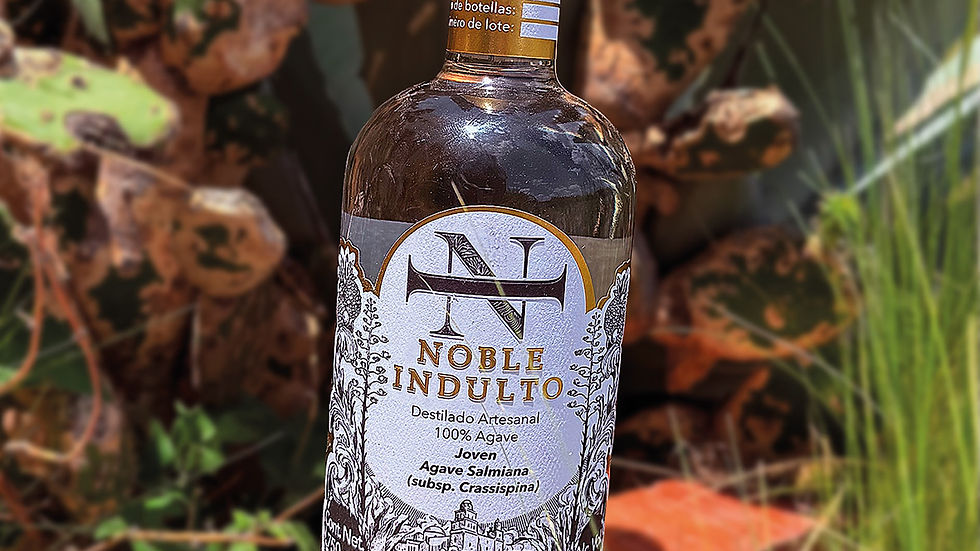
Mezcal Spotlight: Mezcal Noble Indulto
By Jonathan Lockwood
You may already know Alejandro Vasconcelos. If you've been around San Miguel long enough, you probably visited Mezcal-Art, his place near centro, before it closed. Beautiful outdoor courtyard, serious mezcal selection, food that kept getting better. While plenty of local spots were content to coast, Alex kept building — literally. He put a roof over the main seating area, perfected the menu and pumped up the mezcal list even further. I was always impressed.
But Alex, it turns out, had bigger things in mind.
He's 45 now, born in CDMX to a father from Oaxaca and a mother from Celaya. He studied Mechanical Engineering at university, with a minor in Sustainable and Protected Agriculture: a combination that will make a lot of sense in a moment. His mother's family held 200 hectáreas of land near Dolores Hidalgo, and when he was 29, Alex went out there to work it. The land had been sitting idle for years. His first plan was sensible enough: lettuce, corn, the usual. Then the well broke in 2012, and there was no money to replace it. No water, no crops. His cousins in Oaxaca — mezcaleros, naturally — told him to stop crying about it. Agaves, they said. They need almost no water. And once you've got agaves, you might as well make something with them.
So he did.
He built a destilería on the property — Mezcal Noble Indulto — putting in an horno, wooden fermentation tubs, and a still he designed himself. He planted and maintained the agave farm on site, and also works 20 hectáreas in Comonfort, where a microclimate lets him grow Espadín, Blue Weber, and a few varieties that wouldn't do well at higher elevations.
When our group visited recently, Alex brought out his latest Salmiana distillation — clean, mineral, excellent example of the most popular locally made mezcal. He also let us try a distilled pulque that went over well at the table. But what genuinely surprised me were two spirits I hadn't expected. Alex makes a gin with a grape base — so, closer to a grappa — but infused with juniper, rosemary, vanilla, anise –18 botanicals in total. I wanted a bottle immediately. He waved me off; it's currently running well over 60% ABV, and he's going to adjust it down before he brings some out for the Friday Mezcal Club. I'm holding him to that. He also has a brandy, grape-based as well, that's been resting in wood for two years. Delightful.
Alex has always been vocal about sustainability in agave farming, and at Noble Indulto he's putting it into practice. He plants wild agave species annually rather than running monocultures, which protects biodiversity and keeps the soil from the kind of degradation that industrial-scale production tends to cause. He's an advocate for the Billion Agave Project, an ecosystem-regeneration approach that treats agave as a drought-resistant pioneer plant for arid and semi-arid lands — restoring soil, capturing carbon and generating real income for rural farmers without feeding the industrial machine.
He's also working on converting agave mulch into animal feed and other useful byproducts. The issue he's most focused on right now, though, is vinazas — the acidic liquid waste left over after distillation. For years, most producers have simply dumped it on the ground or into rivers. Alex is working on transforming it into a fertilizer, which would be considerably better for the land than the chemical products most operations depend on today.
And you can see all of this firsthand. Alex and his crew offer tours and experiences at Noble Indulto — how he raises agave from seed, how it's planted in the fields, and yes, how it ends up in your glass right there on site. My friends and I have been out a few times. He never fails to deliver something worth the drive.
For more information, email 4agaves@gmail.com, and Alex will point you in the right direction.
Jonathan Lockwood is a Mezcal lover, explorer, and collector and writes the Mezcal Maniac Substackmezcalmaniac.substack.com


Comentarios