.png)


The Artist’s Corner: Filippo Giusti
By Lola Picó
Here we are again, you and I, in this corner, alongside an artist.
Let’s discover him together. This time, the door opens into Filippo Giusti’s studio.
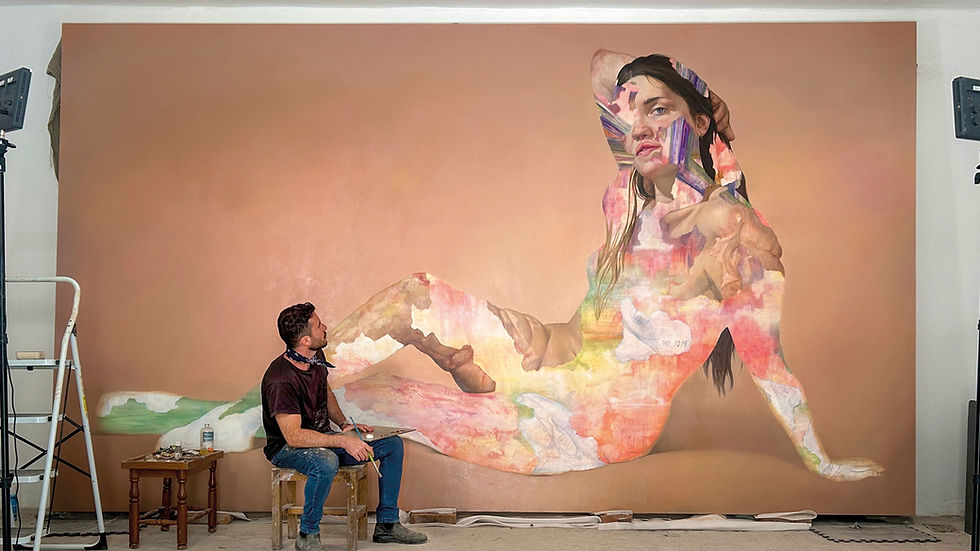
As I step inside, I find myself surrounded by faces and bodies emerging between the figurative and the abstract, layered with shapes and color. There is serenity, mystery, and strength. Moving among his paintings, I sense that Filippo is not simply portraying a face, but reaching for something more intimate.
Painting, however, would take years to find its place in Filippo’s life. As a child, he drew constantly, but soon learned to see it as secondary. He was expected to study, to find a secure profession. He grew up hearing that drawing was no way to make a living and put down the pencil. Life then led him, almost by chance, into acting, theater, and later photography, where he learned perspective, composition, light, and color.
San Miguel de Allende brought him back to what he had left behind. Before believing he could become a painter, he visited artists’ studios and asked whether they actually made a living from their work. He needed to know it was possible. Their answers began to crack that old belief.
On July 31, 2018, he began his first painting. With no formal training and little idea of what to expect, something unexpected happened: he recognized himself. “I felt like the person I was supposed to be,” he recalls. Painting felt less like learning something new than returning to a familiar place. “It was very strange, because I already knew everything without knowing it.” For the first time, he felt empowered. He had found his place. In those early days, he painted until he lost track of time, hunger, sometimes even his own body. There was something instinctive about it. “It just starts,” he tells me. His hand seemed to know before his mind did, as though something that had always been there was finally beginning to reveal itself.
His earliest works grew from his own experiences and emotions, brought to the canvas through magical realism. Later came classical portraits, which found an audience. Over time, however, representing what was visible was no longer enough. Filippo wanted to reach the person beyond what his eyes alone could see.
During the pandemic, when the world seemed to stop, Filippo also paused. He began asking how something he loved could become a way of giving to others. The answer came naturally: empathy. If we were colors, and could see beyond the surface, what colors would we be?
He eventually called this search “Essentialism.” Since then, his portraits have begun long before the canvas—with a conversation. Filippo listens, asks questions, and allows himself to be vulnerable so the other person can open up as well. No code assigns an emotion to each color; the colors emerge as he paints, shaped by the encounter.
“My paintings aren’t that important,” he tells me unexpectedly. What matters, he explains, is taking the time to truly see someone; the painting is the physical trace of that encounter.
Over time, he understood that the purpose was larger than himself. His work became an invitation to approach another person beyond our first impression, before judging them. His process begins with conversation: he asks, listens, and tries to understand. Then come the hours at the canvas, looking again and again. Gradually, that first impression falls away, changing the way he sees the person. In the process, he tells me, he changes too.
One idea seems to capture it: “For me, God—or whatever you want to call it, the meaning of life—is in the face of the person in front of you.” More than observing someone, Filippo wants to sense who they are, beyond that first impression.
As we talk, a parallel emerges. Filippo tries to know the person before bringing them to the canvas; as I interview him, I too am trying to move beyond a first impression. In a way, we are doing the same thing: discovering the person in front of us. Before I leave, I look once more at the portraits. They are the same, but I no longer see them quite the same way. Perhaps that is Filippo’s invitation: to approach one another with empathy, until we meet in what is essential.
You can see Filippo's work at his studio at Fabrica La Aurora, 5D. www.filippogiusti.com/es
Lola Picó is an abstract artist based in San Miguel de Allende and our resident art columnist. Explore her work at


Comentarios